American Avalanche Association
AUTHORITY OVER DEFERENCE
Brand Strategy & Design • Nonprofit Governance & Education • 2025 • North America
A governing body that had kept its expectations collegial gave up the comfort of being agreeable, and handed hundreds of independent providers everything they needed to act without asking.

A3 is the governing body for avalanche education in North America, and it teaches nothing. It sets the standards that hundreds of independent providers deliver to tens of thousands of students every season, which makes it responsible for the quality of instruction it does not personally give. That role had gotten harder to hold: expectations lived in conversations and legacy documents rather than in shared tools, providers understood their own programs well and read their place in the national system differently, and staff carried decades of institutional knowledge with no infrastructure to apply it evenly.
The pull in a member organization is always toward the informal, because the providers are also the members, and writing down what you expect from a peer can feel like an accusation. A3 came to us with the belief already intact, so the work ran from a defined point of view on how authority should behave in a partnership system down into the tools that would carry it: a rewritten education section, a set of student journey maps, and the first Provider Playbook the organization has ever published. The design worked inside A3's existing system rather than replacing it, which is the correct move for an organization whose authority rests on continuity.
OVERVIEW
The engagement ran from a defined point of view on how authority should work across a partnership system down into 10 rewritten education pages, visual journey maps, and the first A3 Provider Playbook.
The playbook became the reference providers work from, adopted across the network as the operating and communication standard rather than issued as a mandate; the rewritten education section is the one A3 runs today.
Specificity is a safety mechanism in a field where the consequences are physical, and providers given exact expectations move faster than providers left to interpret them.
CONVICTION
Governing bodies made up of their own members tend to soften. The peers are the constituents, the standards get carried in conversation to avoid sounding heavy handed, and the organization slowly trades authority for goodwill it already had.
Vagueness feels polite. Leaving room for interpretation reads as respect for someone's expertise, and spelling things out reads as doubting them. That arrangement holds in almost every industry and collapses in this one, because the student who got the uneven class is a stranger standing on a slope reading conditions with whatever they were taught. Specificity is the difference between life and death.
Acting on that costs A3 the easy collegiality it had with its own membership, and some providers were always going to hear a written standard as control over an independent business. It also closes the informal door, since an organization that publishes exactly what it expects can no longer settle things quietly case by case, and has to be willing to say no in public.
What A3 got back was a network that could act without asking. The playbook answered in advance the hundred small questions that used to arrive by email, so staff stopped being the bottleneck and started being the source. It settled the boundary that had been blurry for years, what A3 governs and what a provider owns, which is the line that makes independence workable.
POSITION
The person who decides whether a national standard is real is the one being asked to teach to it. That person is the provider, the independent businesses and instructors who deliver every A3 course in the country, each with their own name on the door, their own curriculum, and their own reputation in a small community where everyone knows everyone.
Students sit second, and what they need from A3 is a seal, the sense that a course is official the way a government stamp or a league mark is official, which only exists if providers hold the line first. Set aside is the provider who wants the recognition without the review, a fair thing to want and the wrong thing to build for.
What A3 offers the ones who stay is bedrock, the layer underneath the business that does not move, that a provider builds on rather than negotiates with, and that makes their work legible outside their own valley.
VOICE
A3's voice is plain, declarative, and unhedged, closer to a briefing than a brochure. It states jurisdiction rather than implying it, names consequences without theater, and sorts people by their situation instead of talking to everyone at once. Everything below is that register built into the tools.
Verbal identity
The organizing sentence is a division of labor stated out loud: A3 sets the standards, and recognized providers deliver the training. From there the writing keeps saying what A3 does and does not do, that it approves instructors and programs rather than teaching courses, and it puts the stakes in one flat line, that your life depends on the quality of the instruction.
Digital
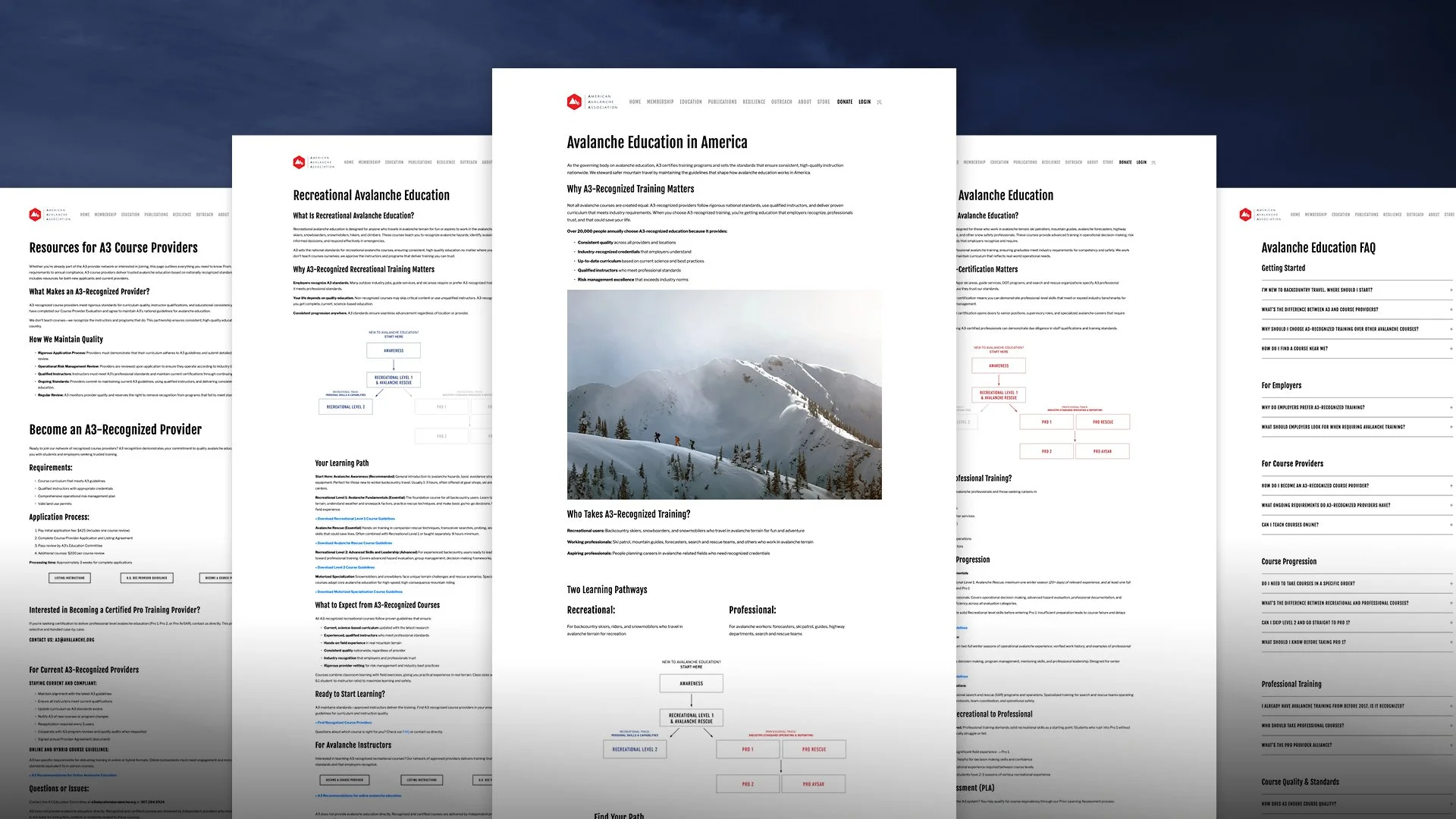
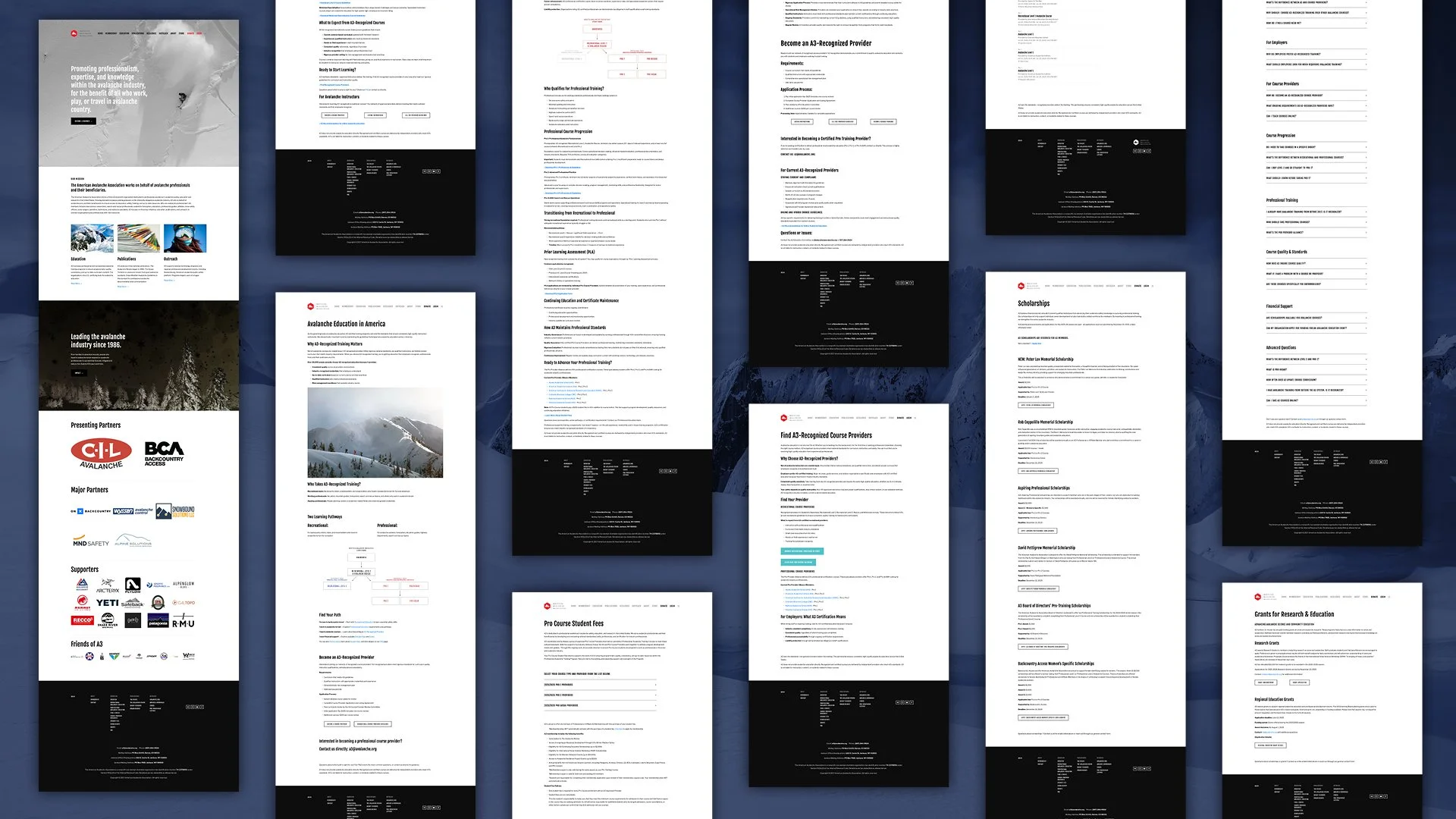
The education section of the A3 website was rebuilt across 10 pages and routed by intent, so a reader arrives and picks the sentence that describes them: new to backcountry travel, working in avalanche terrain, teaching courses, or needing financial help. Each path resolves into what the person should do next, which is the whole voice working structurally, the organization sorting people by situation instead of making them read everything.
Journey Maps
Visual progressions showing how courses connect and how different goals produce different routes through the system. Complexity that used to require a conversation with staff now reads in a glance, which is the conviction working at the level of a diagram: specificity made visible.
The Playbook
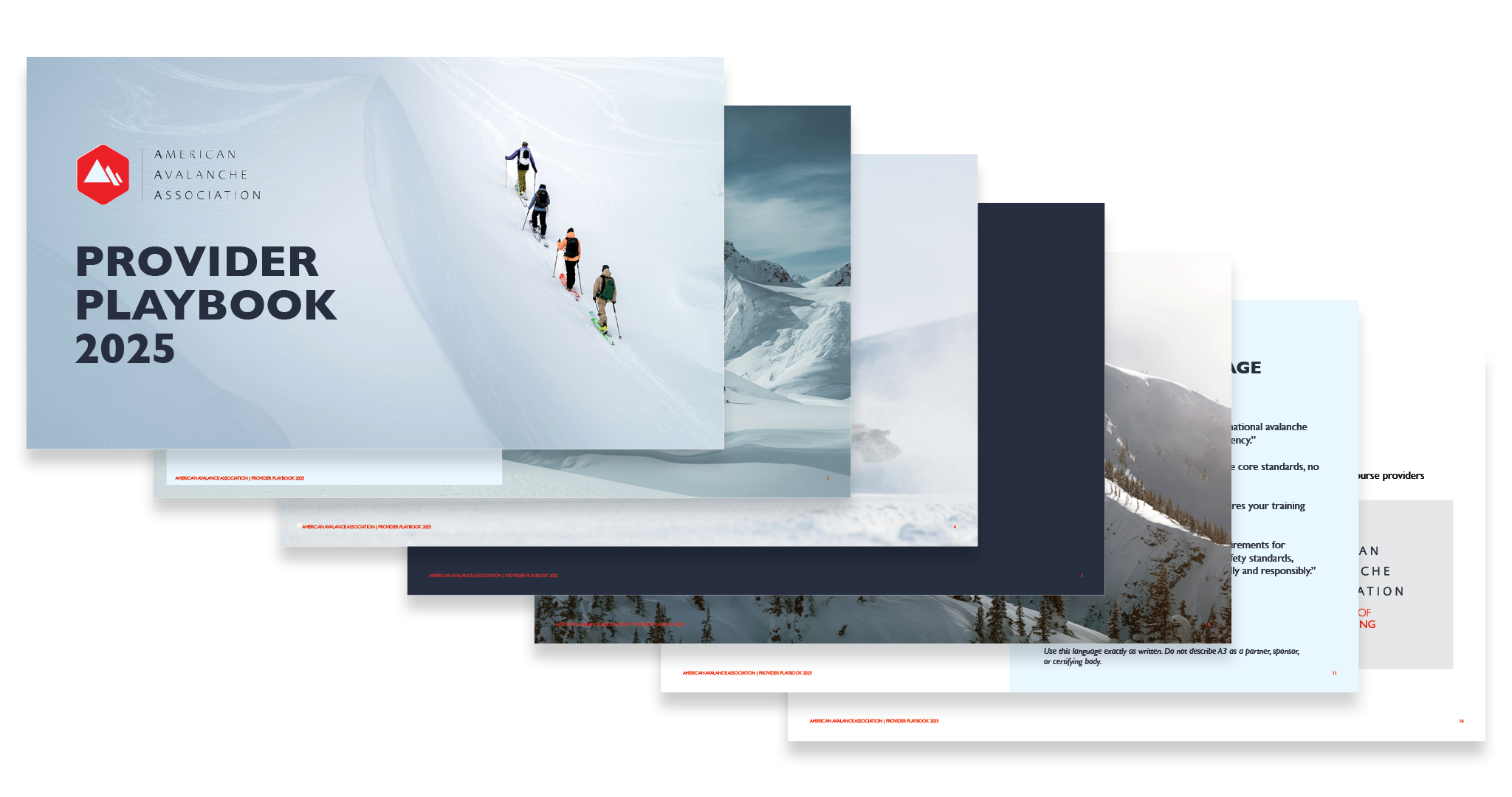
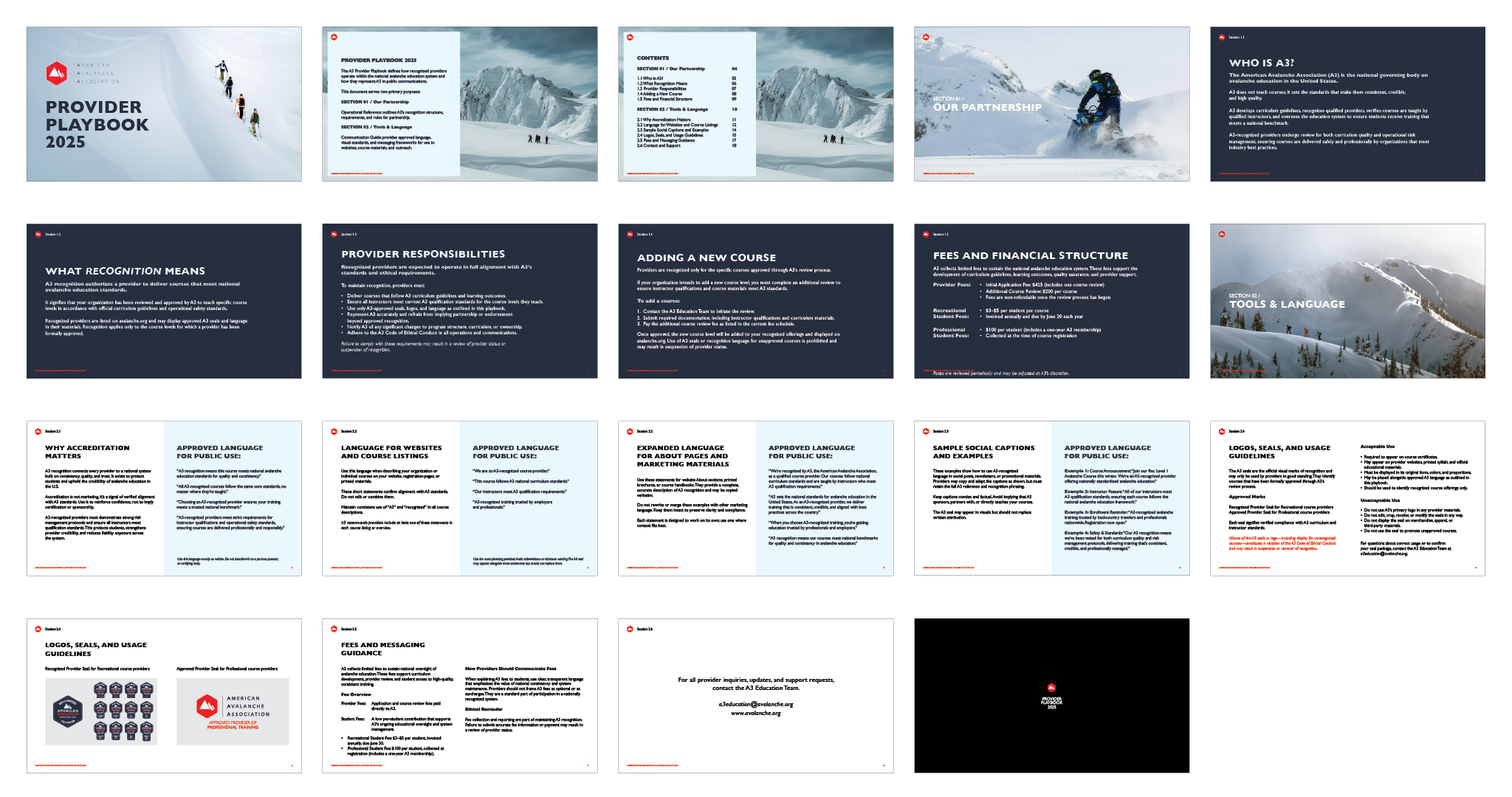
The first Provider Playbook A3 has ever published. It sets partnership expectations, standards, approved language, and visual direction in one place, designed as a working document rather than a policy binder, so a provider can represent a national body correctly without a single permission request. The craft of it is the argument, an authority legible enough to follow is an authority worth following.
BEHAVIOR
A3 has always given the field more than it charges for, from published research to grants to a therapist directory for people whose work involves recovering their friends. This work extended that habit into the place where authority usually turns into paperwork.
The Provider Playbook was given to providers rather than demanded from them, carrying everything a partner needs to act on their own. The scholarships and grants that fund people into the profession, including support aimed at those the field has historically left out, moved from a buried page into the education path where somebody deciding whether they can afford this will actually find it.
The standards, course requirements, and progression criteria stay open to anyone, including people who will never pay A3 a dollar. An authority that hides its rulebook is protecting itself, and A3 does the opposite in a field where the cost of not knowing is measured in bodies.