Venom
PROOF OVER OPINION
Brand Strategy • Specialty Outdoor Apparel • 2025 • North America & Europe
A launch team with a product and no agreement gave up its assumptions for 15 conversations, and came away knowing the person it was building for.

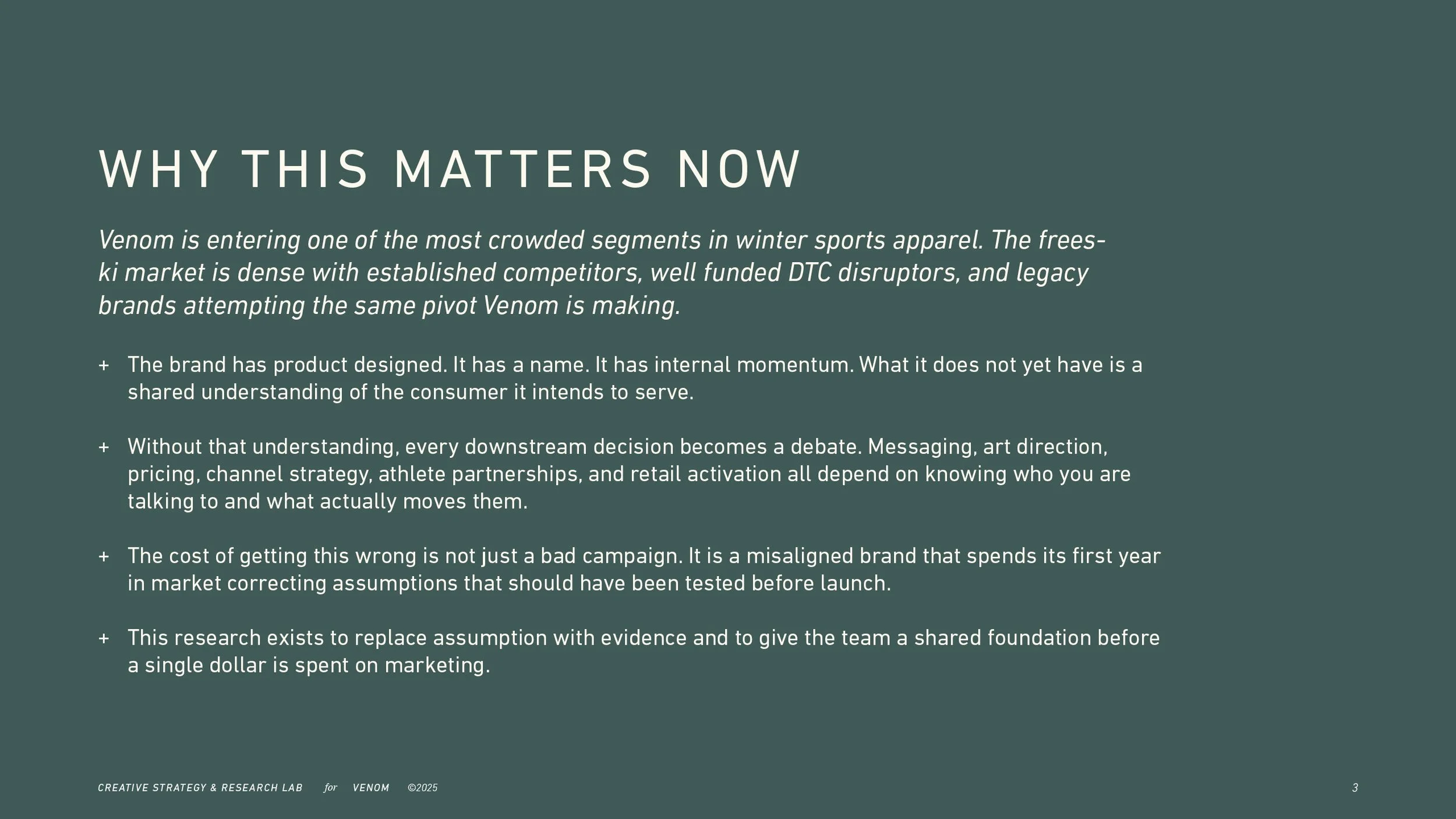
Venom came out of Spyder's heritage IP, built to reach a younger freeski consumer the parent brand's alpine identity could not. The product was designed, the name was chosen, and the launch was moving. What the team did not have was agreement about who any of it was for. Every stakeholder carried a different version of that person, each built on anecdote, and every decision about art direction and messaging became a debate with nothing underneath it to settle the argument. So the engagement was research and positioning, find the person, name the belief, and hand the rest of the chain a foundation it could build on.
OVERVIEW
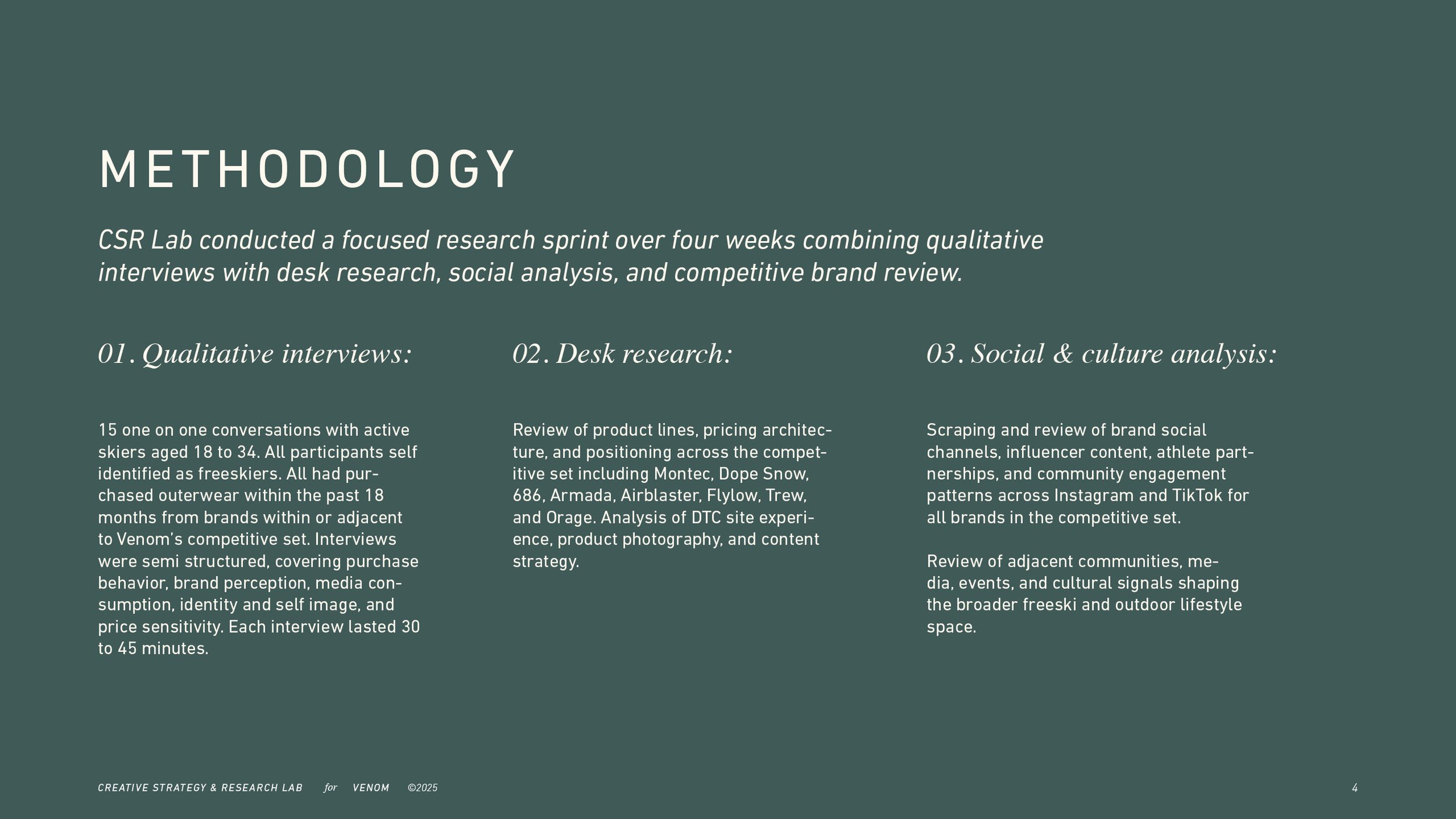
The engagement covered 15 qualitative interviews, competitive analysis, and cultural scanning across freeski and adjacent markets, delivered as a designed research report.
15 interviews overturned a go-to-market the team had already agreed on, before a dollar went into launching it.
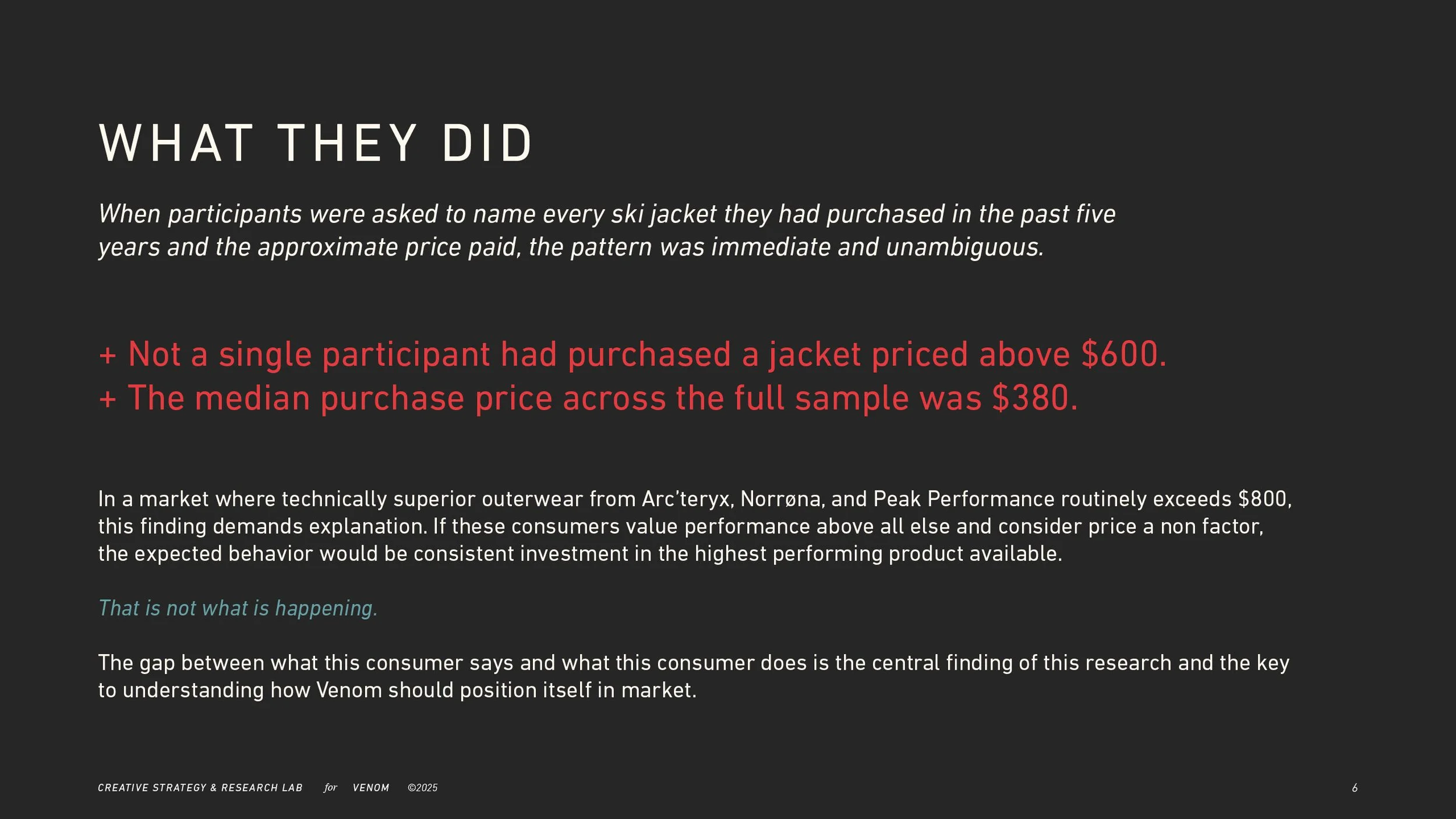
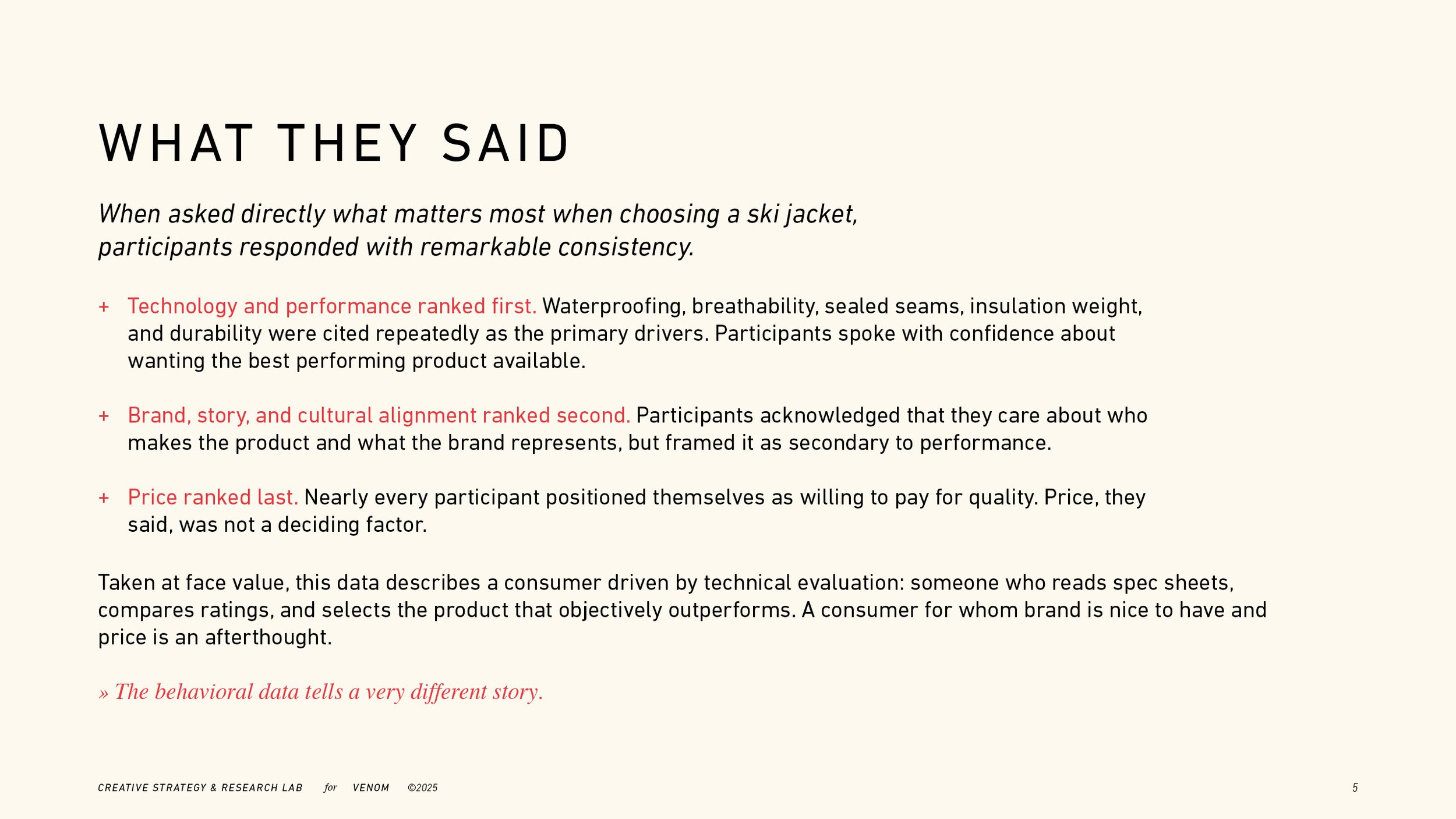
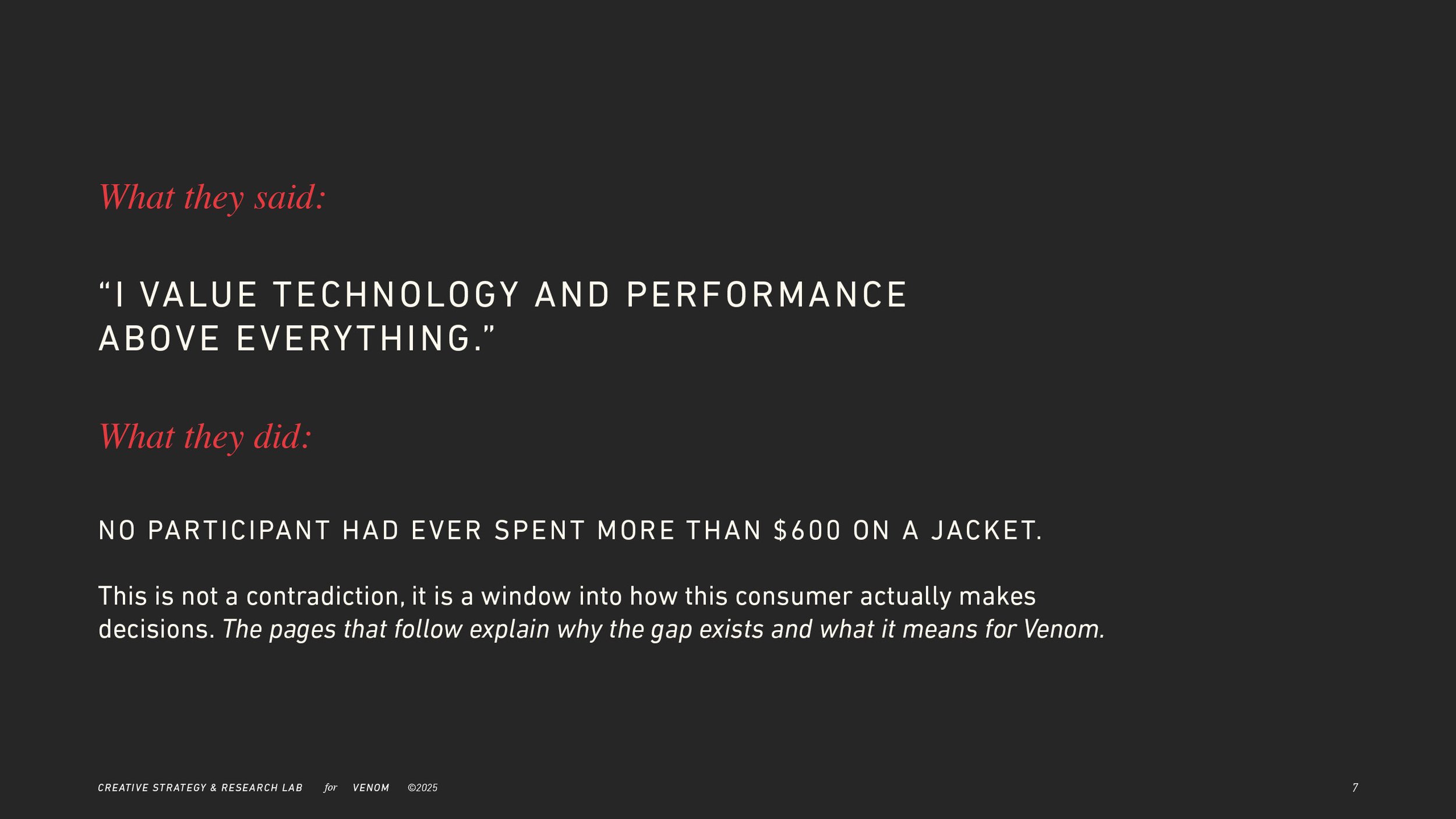
The audience ranked technical performance first and had never once paid for it.
CONVICTION
The whole category assumes this skier buys on specification, because that is what they say, first and loudest. We built the research to find out whether the thing they say is the thing they do.
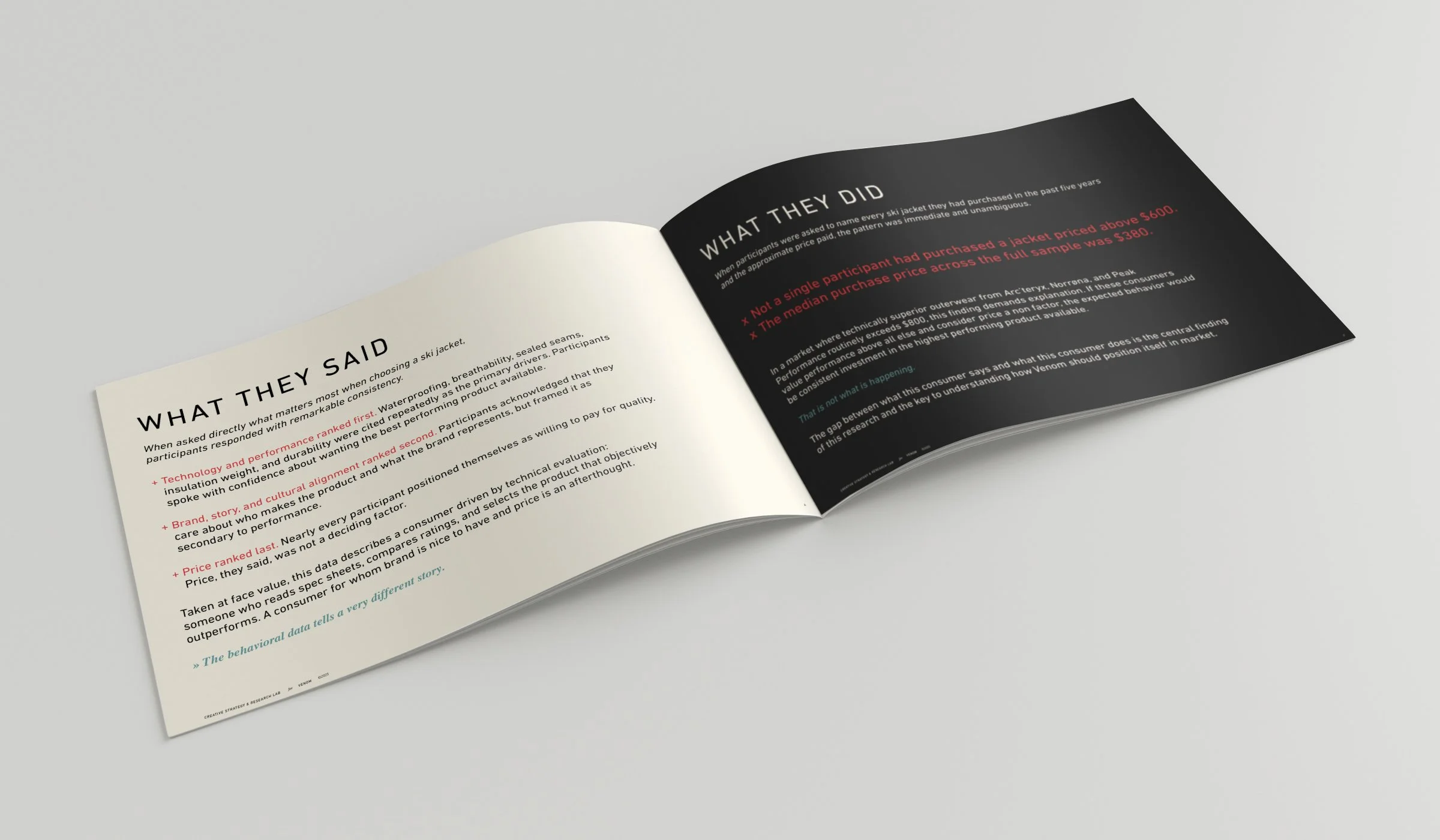
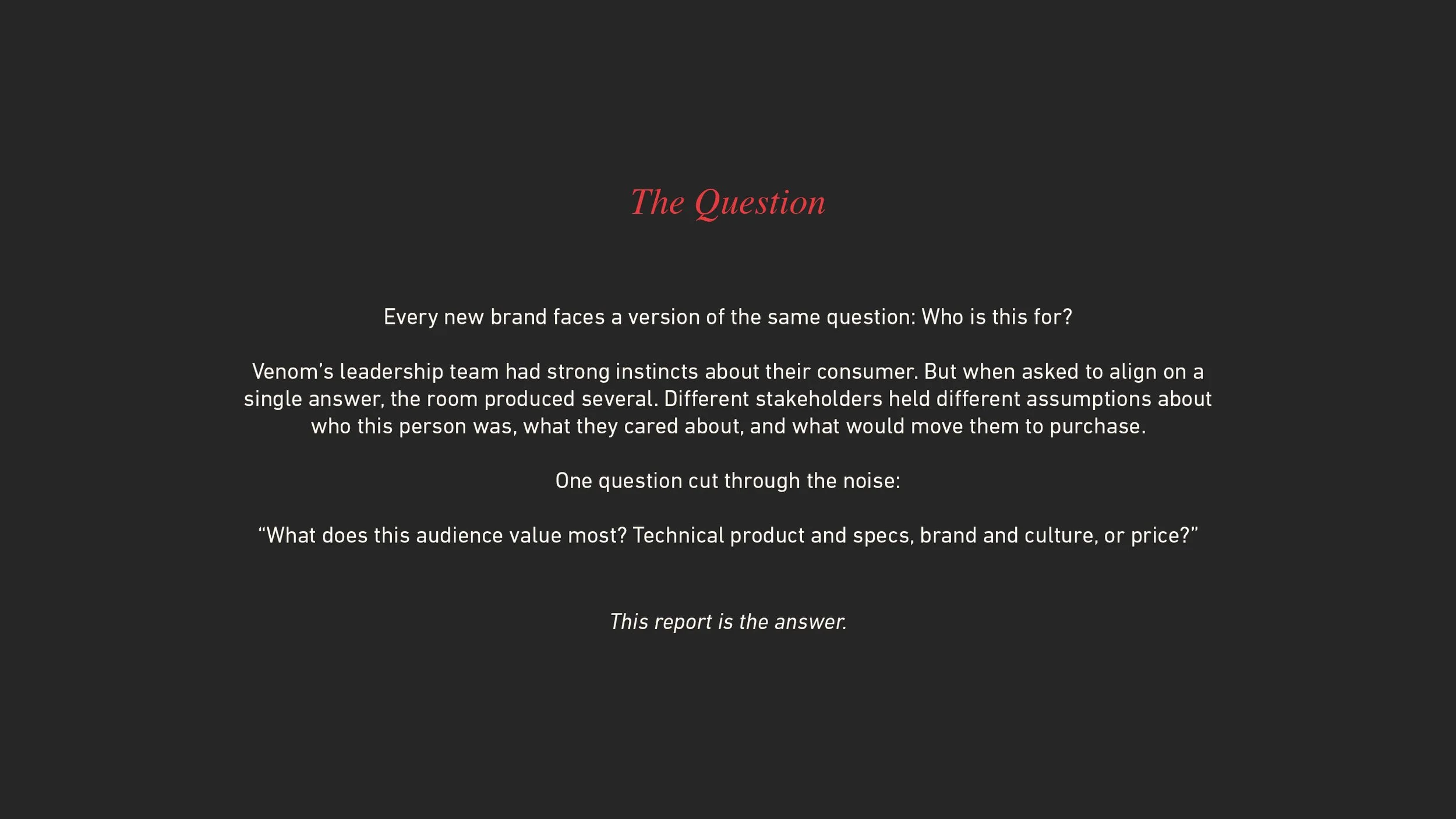
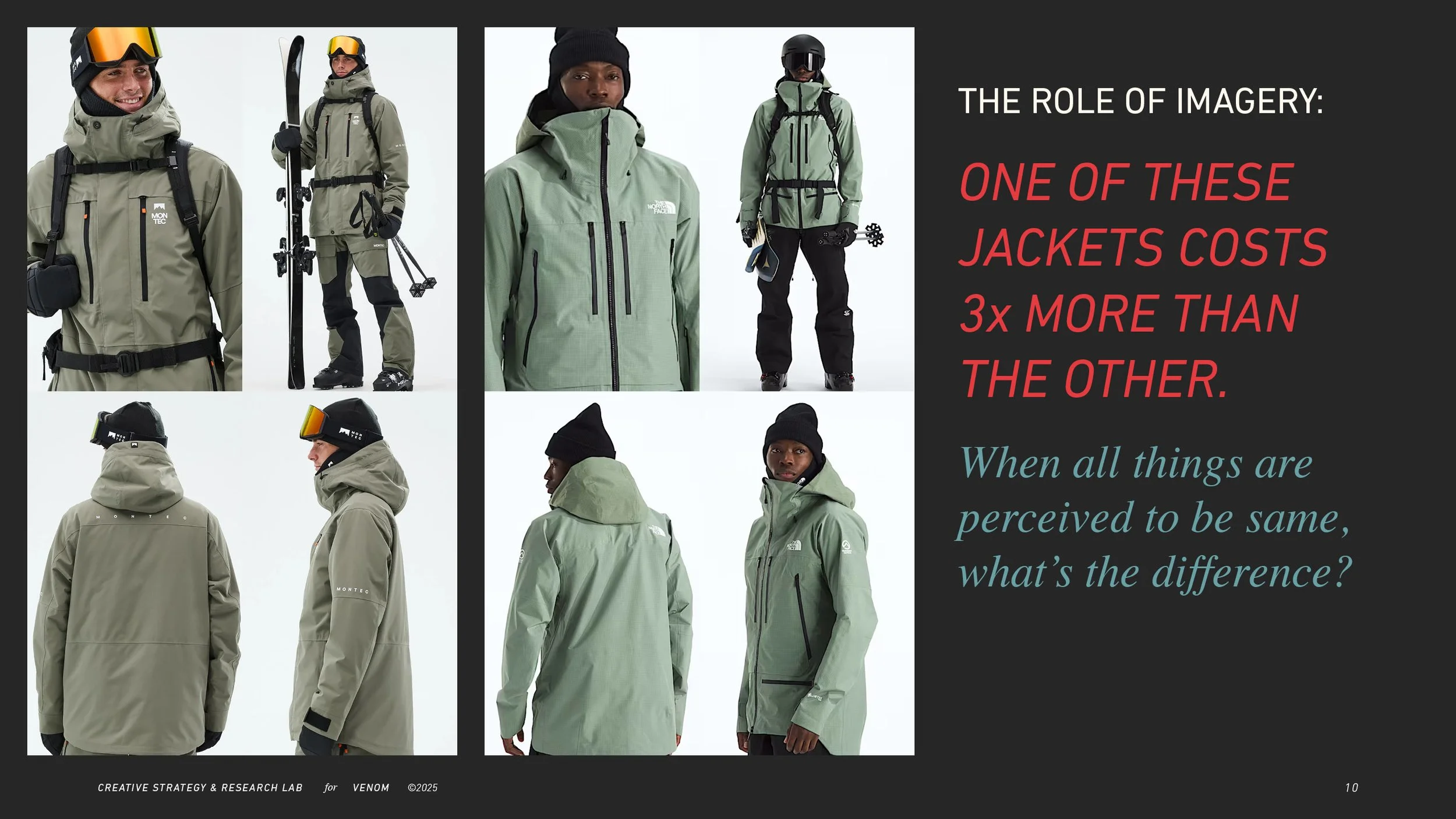
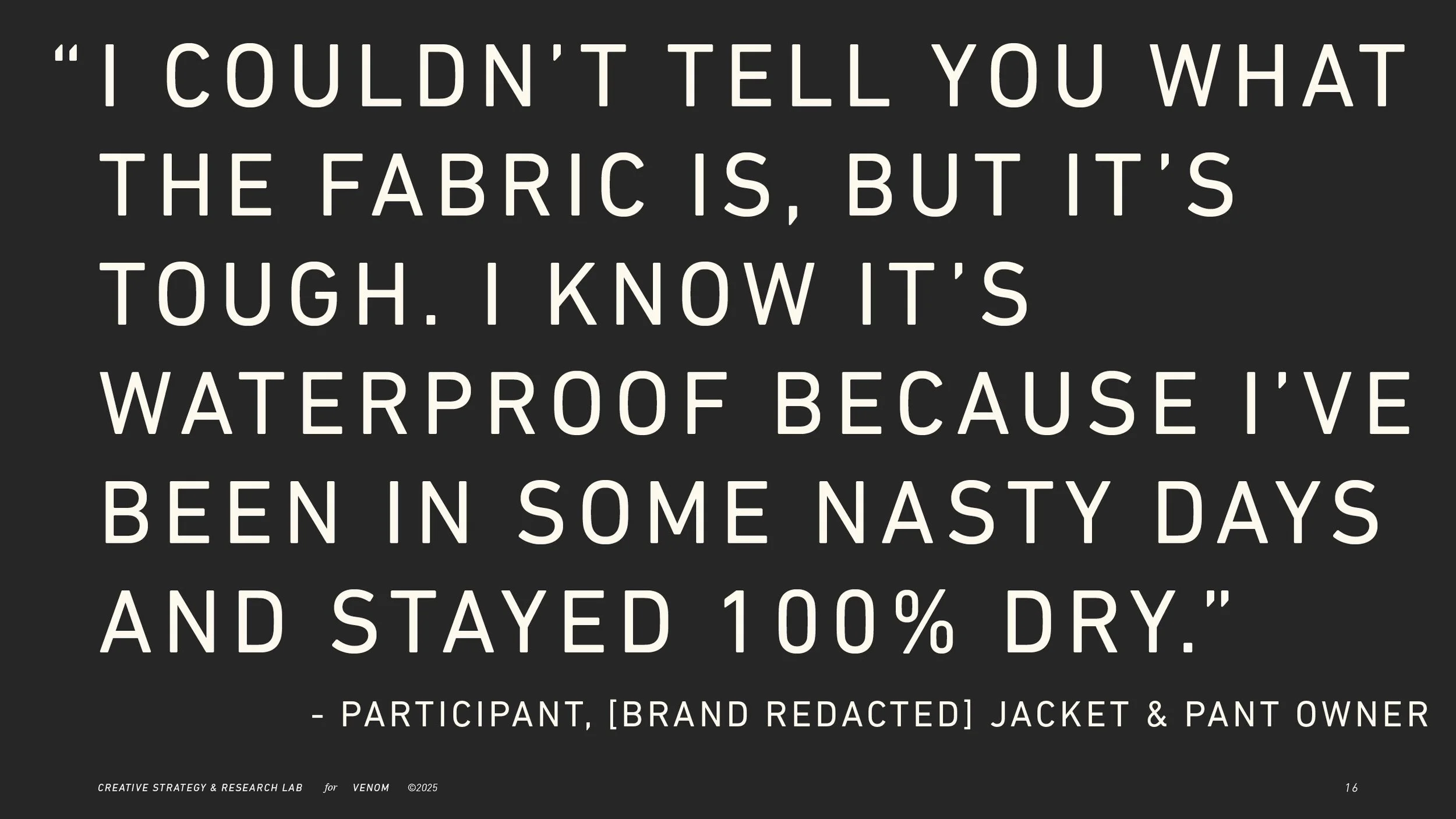
The VP of Marketing handed us one question to resolve, whether this audience values technical product, brand and culture, or price, because every downstream debate was really that argument with no answer underneath it. Participants ranked technology and performance first, brand second, and price last; a ranking that would have marched the brand straight into a spec sheet. Then the purchase history said the opposite. Not one participant had ever paid more than $600 for a jacket, and the technically superior outerwear they claimed to want runs $800 to $1,200.
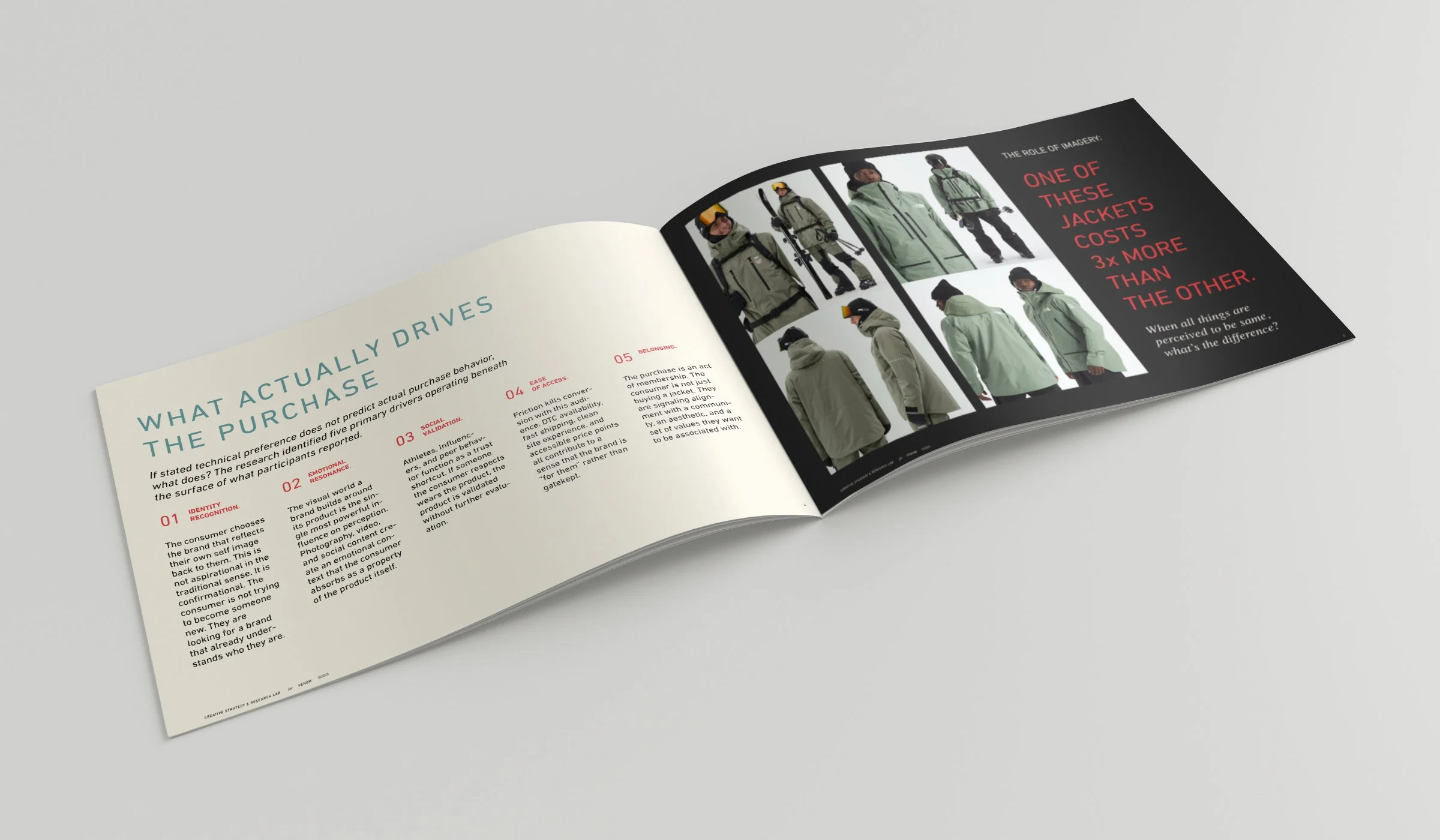
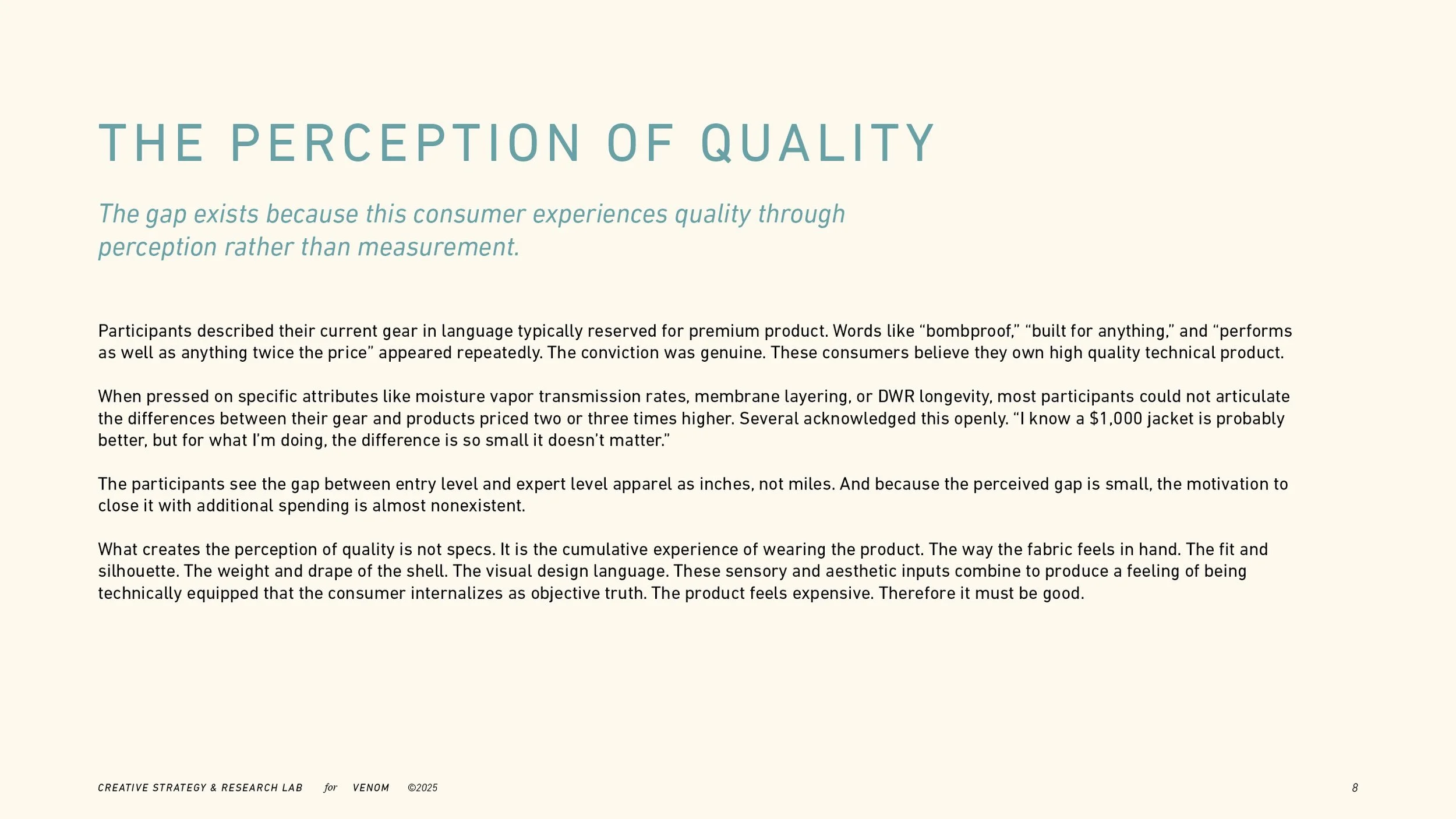
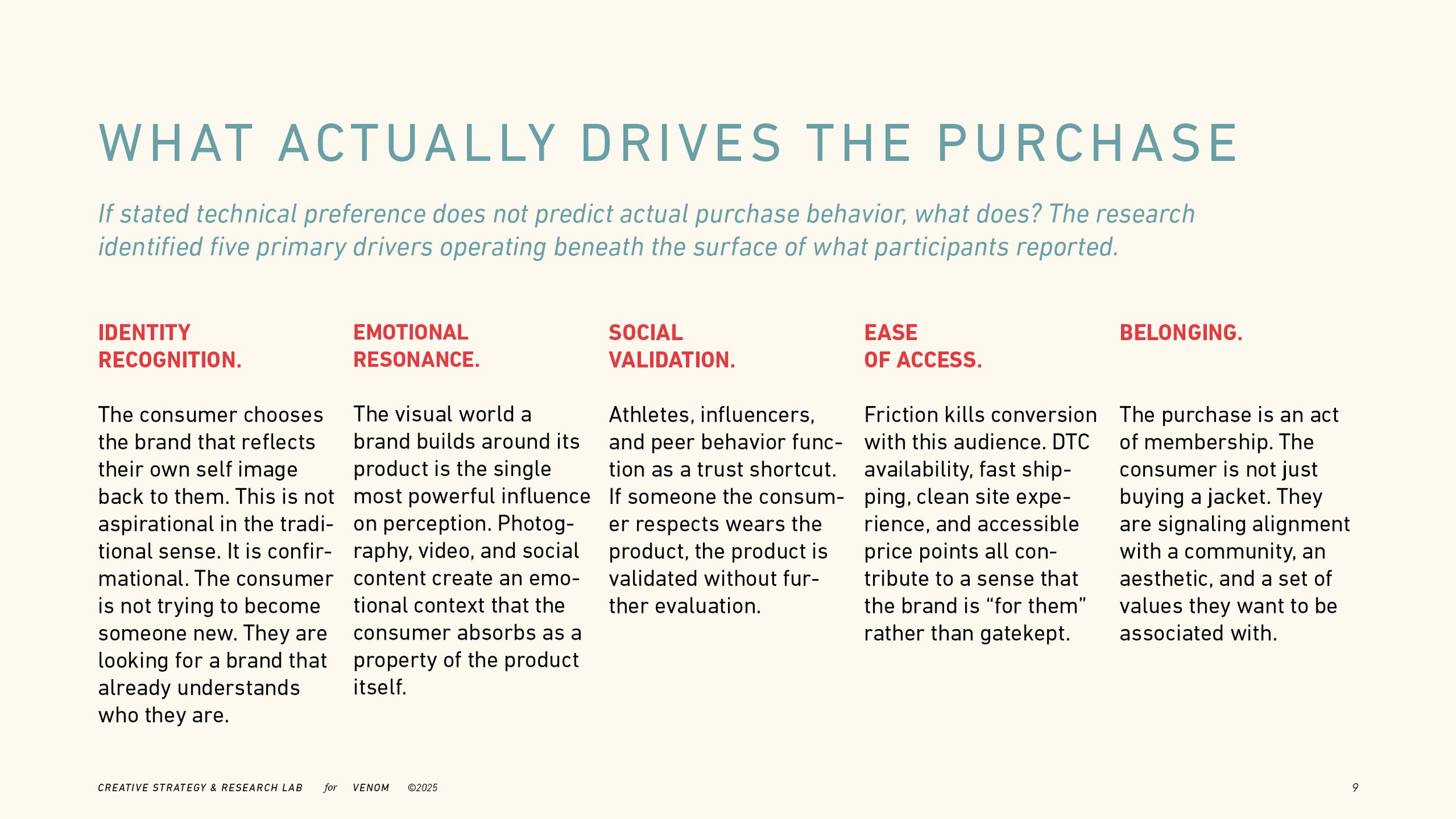
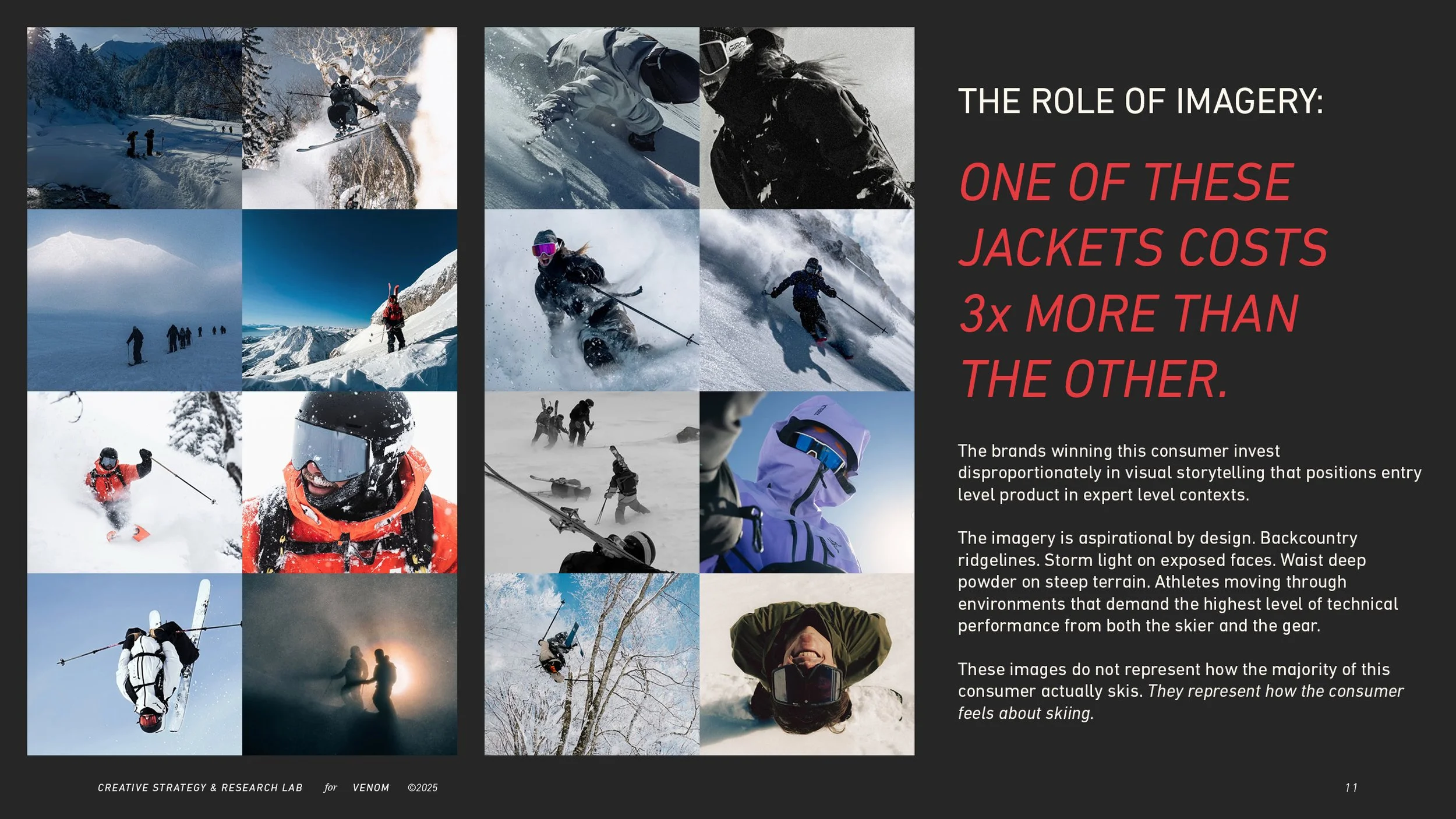
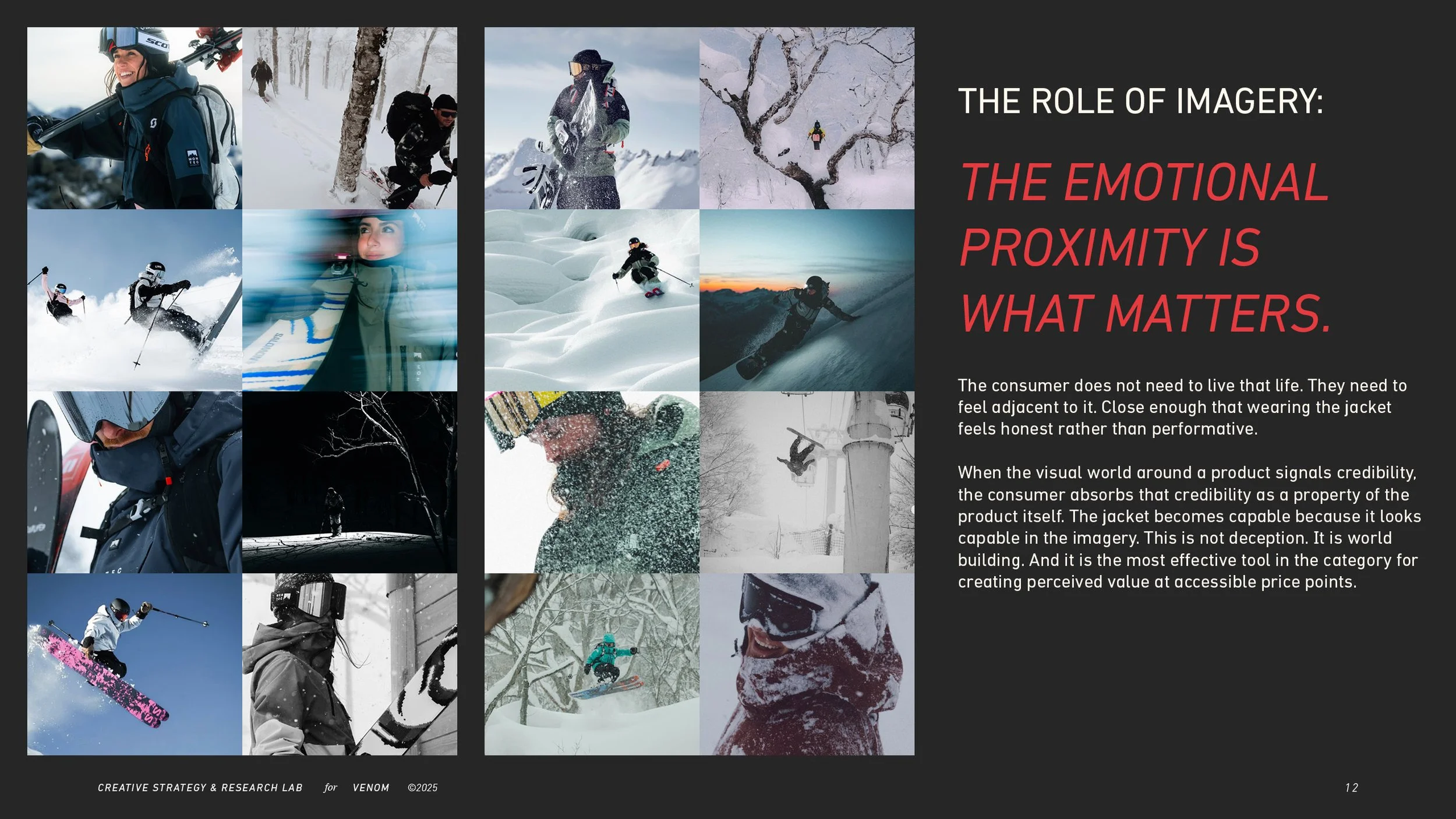
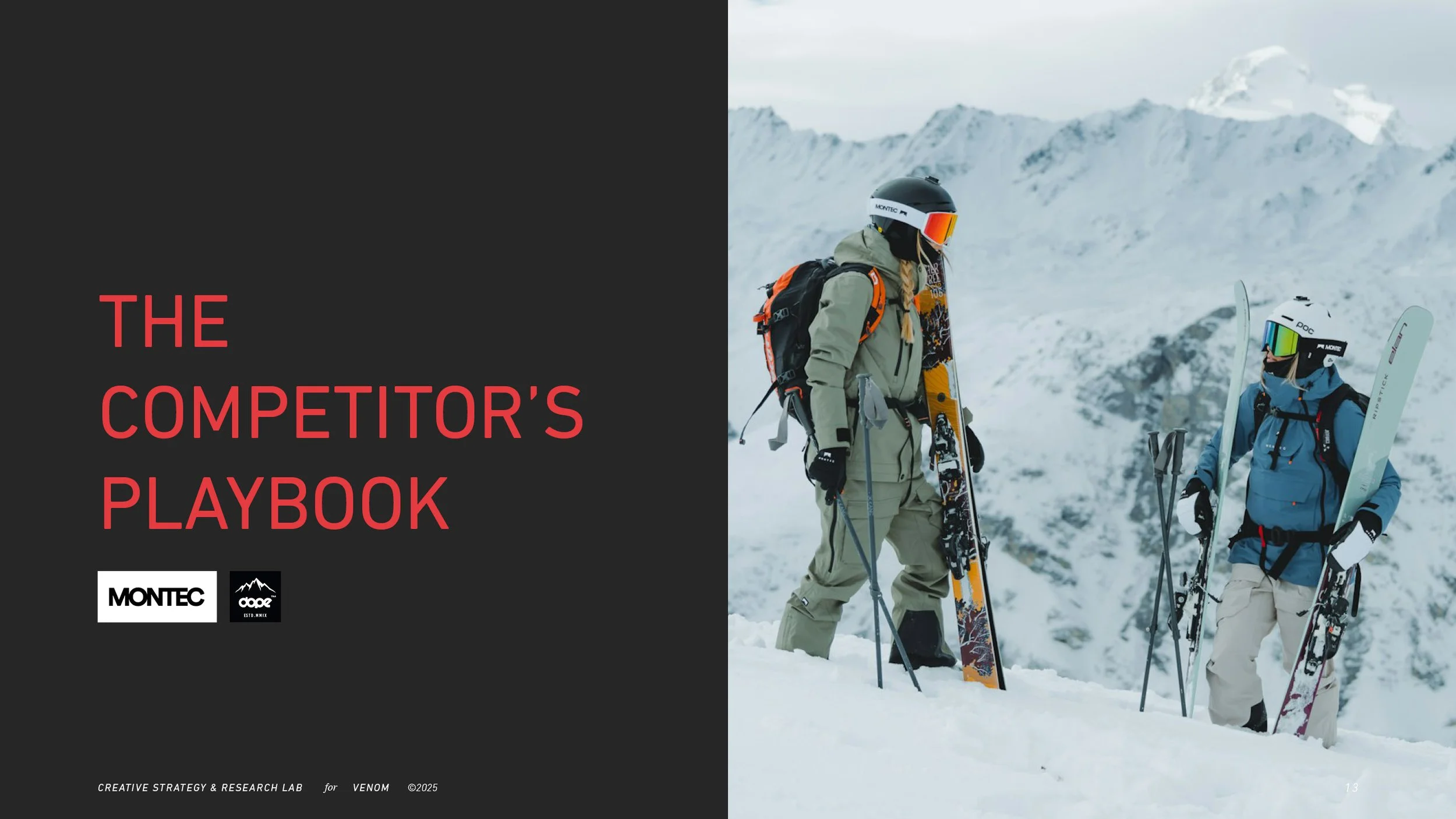
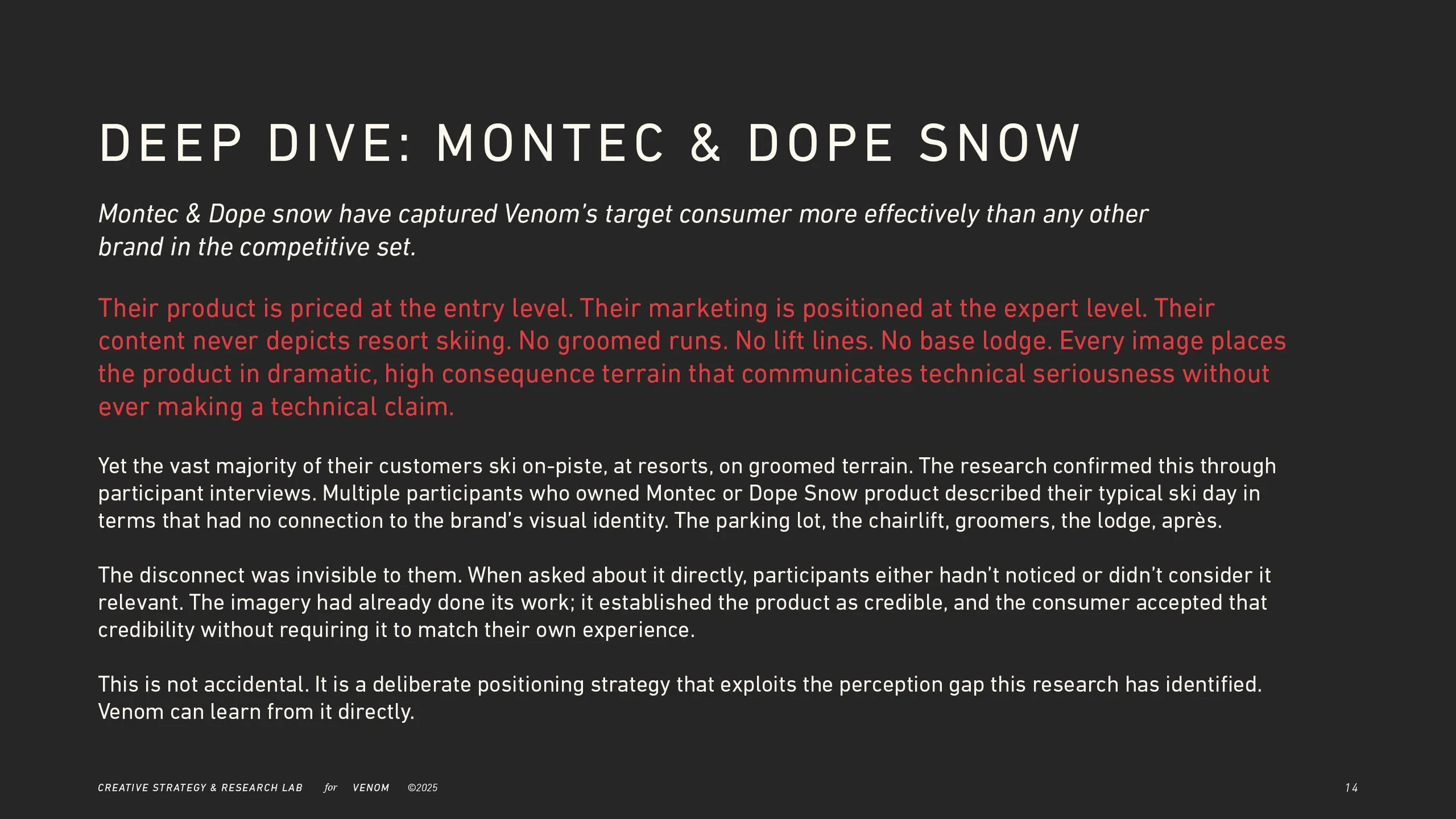
This skier buys a feeling. Entry-level apparel can feel expert on the mountain, and that feeling does the work the specification was supposed to do, which is why brands winning this consumer lead with an aspirational image rather than a materials list.
Committing to that costs something; it means walking off the spec sheet where every competitor stands and every claim can be defended with a number. A brand that sells a feeling has to be right about the feeling, with nothing technical to hide behind, and it means building for the resort skier having a great day rather than the credentialed core who reads the materials list first.
POSITION
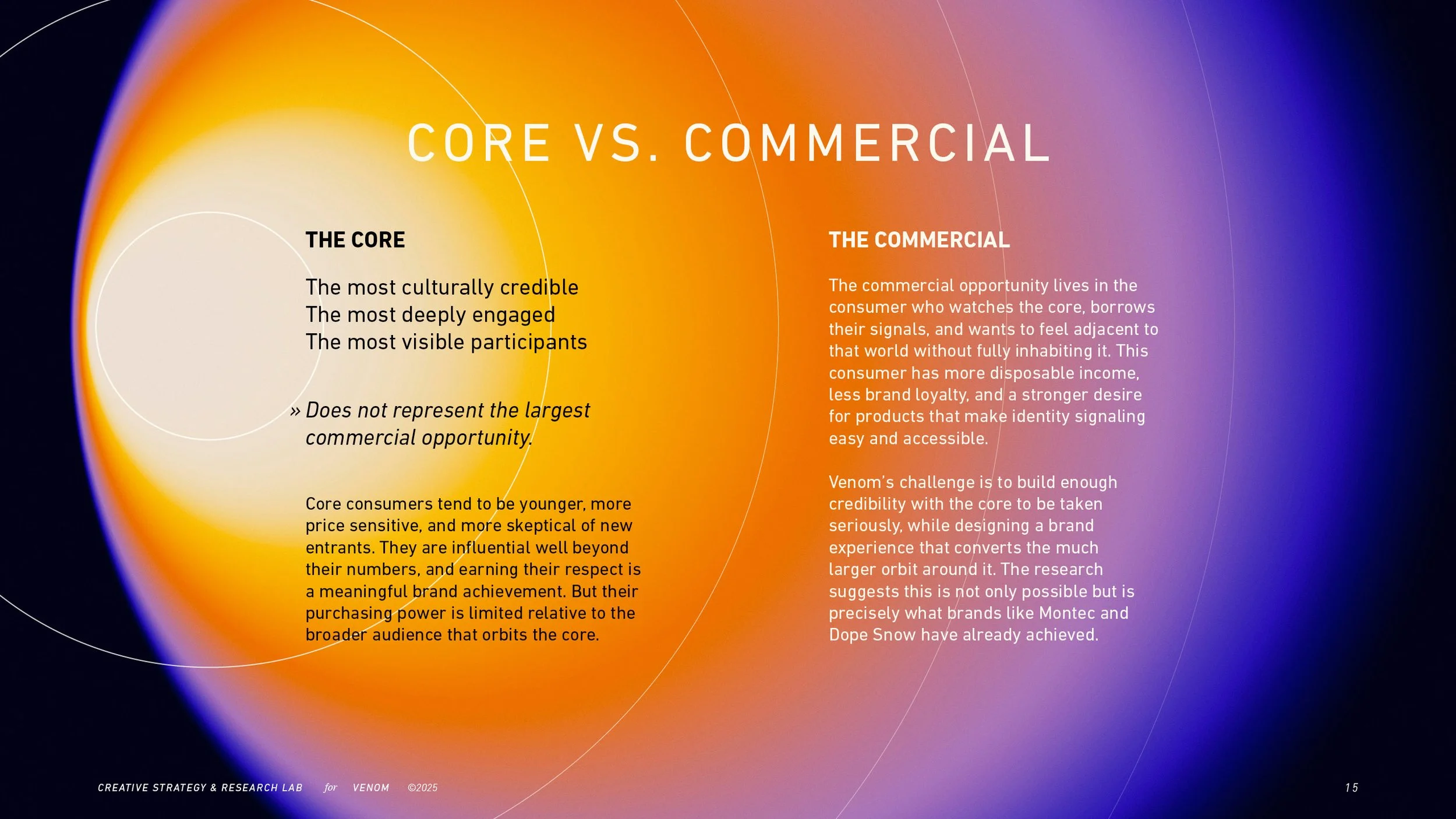
Venom's choice was commercial, and the thing it chose to give up was the core.
The skier it is built for loves the sport but lives outside its center, whose devotion is real and whose weekends are spent at the resort rather than in the backcountry, who cares how the gear looks and how it performs and is drawn to the culture of skiing as much as the act of it.
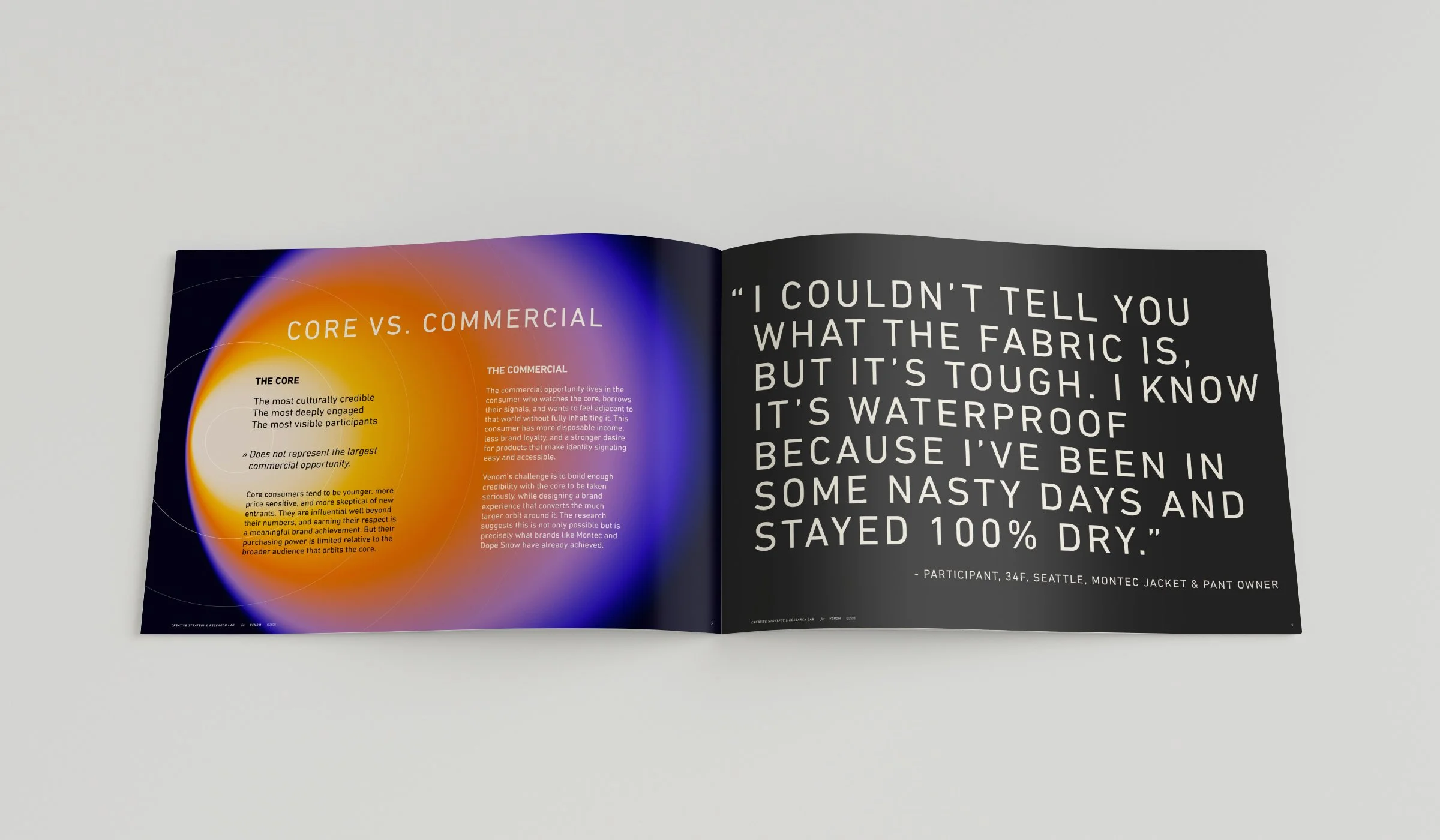
Choosing them set the credentialed core aside as the commercial target, because the core, right as it is, is simply too small to build a business on, while Venom is built to reach the far larger group who love skiing just as sincerely from one step outside. The brand stands as obsessed, for people whose love of the sport runs deeper than their place in its hierarchy.
Venom inherits what it is rather than performing it, drawing on real freeski heritage rather than manufacturing a look, which lets the apparel lean genuinely core in its design without straining. The marketing reaches wide and the product stays true, and the two hold because the history underneath them is real. What a person says they value and what they actually buy are rarely the same thing, and that gap is where Venom gets built.
REPORT
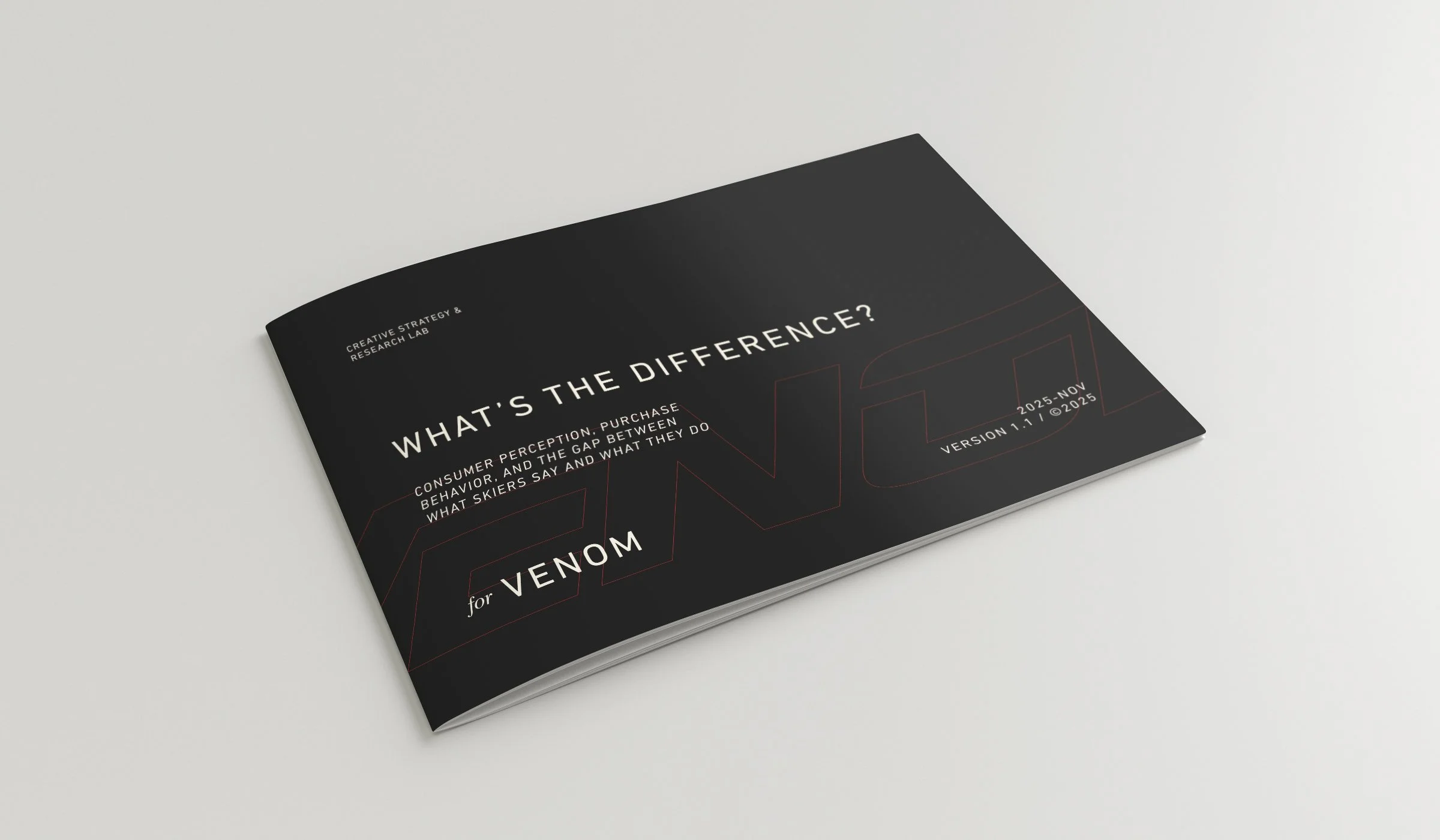
The whole engagement came down to one artifact, a research report designed to be read and used rather than filed. We wrote and designed it as an A5 print piece, cover to spreads, so the finding that overturned the launch would land with the weight it deserved and travel through the building intact. A conclusion that survives the meeting is worth more than one that only survives the deck.
The belief, the person, and the proof behind both sit in a form the team could hold, pass around, and build from. The identity work that follows will be built to it.
Venom launches Fall 2026.